
As a growing number of Europe an countries prepare to lift their lockdown restrictions, it is time to have a look at the economic damage in the wake of the pandemic. And let’s not fool ourselves: it is likely going to be considerable.
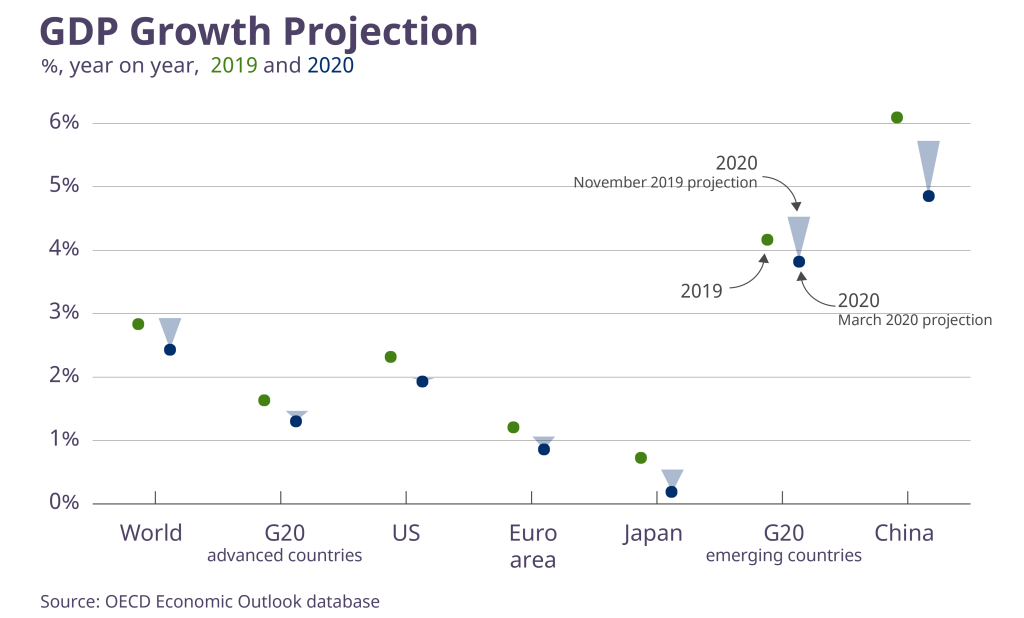
The OECD Economic growth forecasts provided at the beginning of March make already rather grim reading with GDP-growth for 2020 of 0.8% for the Euro-area and the U.K. and 1.9% for the US, all having already been revised downward since the last outlook in November. And the picture has most certainly got rather gloomier still since.
Equally grim are the latest figures from the IMF, which expects that the world economy is going to experience the worst recession since the global depression 90 years ago, with GDP falling by 3% year-on-year in comparison with a modest reduction of 0.1% during the global financial crisis of 2009.
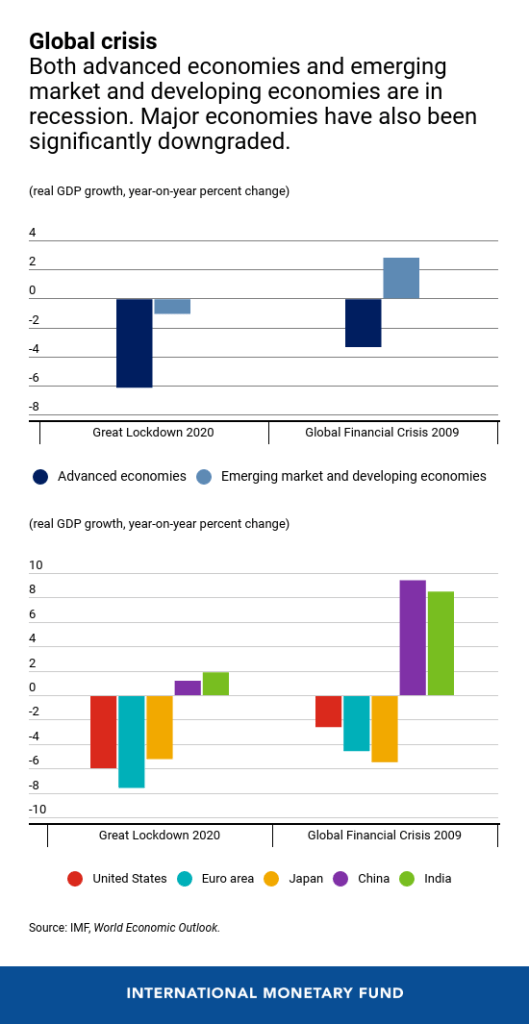
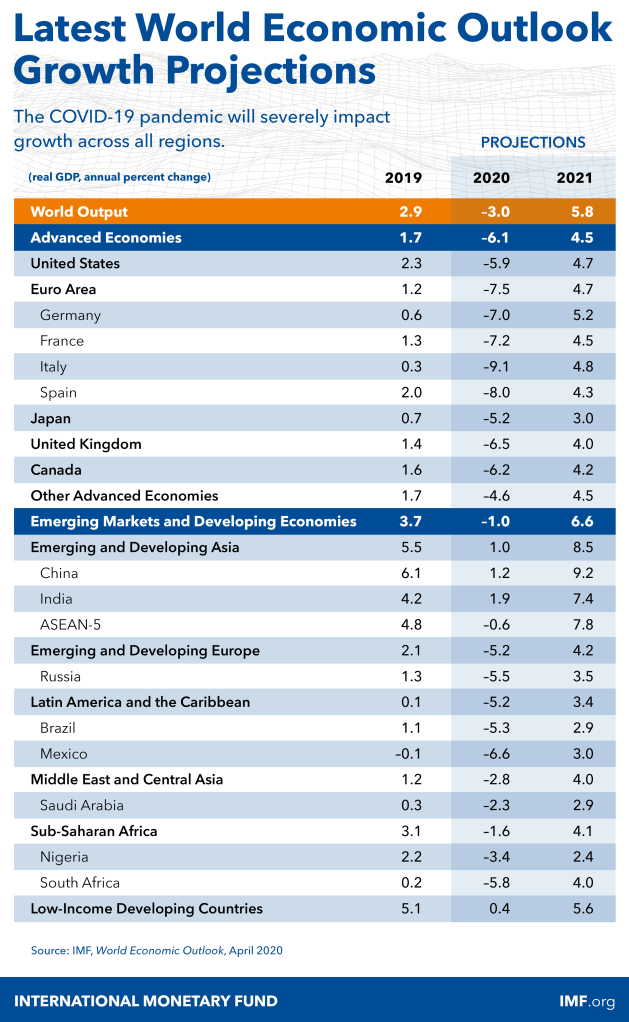
Growth on the other hand, once all of this is behind us (and it will be, trust me!) is going to be quite robust as the IM F forecast below shows. Nevertheless, it may well take more than a year to recover the ground lost.
Scores of companies have furloughed their staff where possible (such as in the United Kingdom) or put them on short time working in Switzerland (this, by the way, applies to me as well), where the government picks up part of the wage bill. And only over the past 3 weeks some 10 million US workers have applied for unemployment benefits. But particularly in emerging economies this is not an option for most people who are lucky enough to have a job, let alone for the many in the underground economy.
As I have already written in a previous blog, many supply chains will be reconfigured, this time with less emphasis on cost and single sourcing but reliability and proximity, albeit at a higher cost. This means that less products or their components will be sourced in low-cost emerging economies, which will leave many of these countries finding it harder to grow in coming years. And, of course, a likely consequence for us as consumers will be higher prices for many items of our daily lives.
Industry, construction and some part of non-essential retailing will probably be among the first sectors to reopen, followed by offices and travel. But let’s make no mistake, social-distancing is going to be a prevalent theme in our daily lives for many months to come, be that at work or while travelling. This also means that it will probably be a while before air travel will recover to pre-pandemic levels, irrespective of whether this is fit business or leisure, and teleworking (or home-office) will remain a prevalent theme for many businesses in the future, reducing the amount of office space ultimately needed.
This pandemic will also alter the way businesses organise themselves: Executives and core workers will remain on the payroll, but many clerical or menial functions will be outsourced to contractors and freelancers, pushing more jobs towards the gig economy exactly at a time when more workers are actually looking for the security of a corporate role. Many people losing their job in the current downturn may struggle to find gainful employment in the corporate world and social inequality is likely to increase as a result. Economists at Goldman Sachs, an investment bank, expect unemployment in the US to reach 15% later this year. It is important that our governments are aware of this risk (I might – and actually I hope I am – be wrong after all) and ready themselves to take further preventive or corrective action if necessary.
The recovery will be long and arduous, with scores of businesses unlikely to survive and the ones remaining bound to make painful adjustments. It will take time for ‚normality‘ to be restored and a few thoughts as to whether it is really desirable to go back to our good old ways in every aspect of our lives won‘t go amiss. As the globally reduced industrial activity and travel has shown, many cities have experienced the lowest pollution levels in a long time. And the lockdown will hopefully have motivated us all to think about the deeper meaning of our lives and to be more considerate not only to our neighbours but also society as a whole and the environment.
 The grumpy older man