
El Salvador ranks 124th among 189 countries in the Human Development Index and with a GDP of $4100 per head of its population of 6.4 million certainly ranks among the poorest countries. But that, if all goes according to the plans of its President, Nayib Bukele, could all soon change. While a law passed in June made El Salvador the first country in the world to accept Bitcoin as legal tender, President Bukele now wants to build Bitcoin City, a metropolis which would be circular, with an airport, residential and commercial areas, and feature a central plaza designed to look like a Bitcoin symbol from the air. Geothermal energy would be provided from the Conchagua volcano in southeastern El Salvador, while the city would not levy any taxes (property, income or capital gains) except for VAT. “This is going to make El Salvador the financial center of the world,” President Bukele declared.
Construction is supposed to begin next year and the cost will be financed initially by government bonds backed by the cryptocurrency. The first 10-year issue would be worth $1 billion, and carry a coupon of 6.5%, with half of the sum going to buy Bitcoin on the market and the other half used for infrastructure and Bitcoin mining.
The city itself would cost roughly $17 billion to build, which is in line with the plans of someone who once used his Twitter bio to refer to himself as “The coolest dictator in the world.” The construction would be partly financed by the mining of bitcoin using the geothermal energy of the nearby Conchagua volcano.
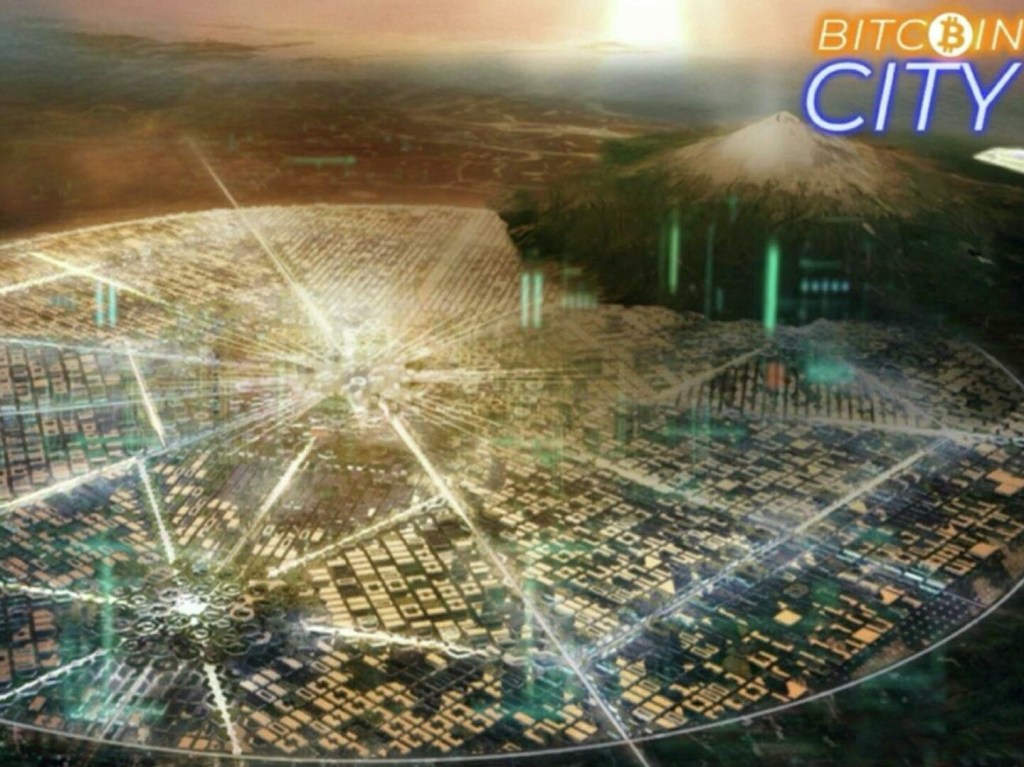
One would imagine that a country such as El Salvador would focus on alleviating poverty and promoting, for example, the education of its children. But no. This once more goes to show, that authoritarian governments put vanity and headline grabbing initiatives before the interest of their population. So here we have it, Wall Street und the City of London eat your heart out! Your days are numbered and before too long now the movers and shakers of the financial industry will be permanently relocating to El Salvador. Here some advice though for President Bukele and the architects of Bitcoin City of what you will need to provide for the city’s future residents:
- A state of the art airport: And make sure it offers all the amenities for the discerning traveller, including ample parking space for private jets of course.
- Shops and restaurants of the highest standard: Only the most luxurious will do for this crowd, so better start talking to the posh brands and the Michelin-starred chefs right now to get them to open establishments in your neck of the woods. Discounters and fast food chains needn’t apply.
- A selection of 18-hole golf courses: When not in endless meetings, whining and dining their illustrious clients (see bullet point above) or glued to their computer screens, this is the type of crowd that will spend considerable time on golf courses. and because no one wants to play the same course all the time, make sure you provide a few of them, obviously designed by the best and to the highest standard.
- Booze and drugs: Make sure you have both of them in ample supply! For one this is the type of clientele who likes to indulge (and can afford to), but also because they might have to dull their senses once they get bored out of their minds in Bitcoin City.
But then again, Bitcoin clearly is not offering any refuge from a Covid-induced market rout: In line with ‘traditional’ financial markets, the value of Bitcoin as well as all or most other cryptocurrencies have been just as volatile, proving wrong those who assumed that cyber cash in general was a suitable hedge against market volatility.
So President Bukele may want to give it some more thought, whether Bitcoin is really well suited to establish El Salvador as a global financial player. And I think the funds could be brought to better use by being vested in the country’s dilapidated infrastructure. Your population would be grateful.
 The grumpy older man
First I’ve heard of this. Then, the rock I live under shelters me from more than snow and MSM. Quite interesting. Put to mind of “engineered” cities – Brazilia, and indeed engineered countries Qarar[?] not surprising we don’t see more of this thinking. Unique here is that the “engineer” looks to draw resources from the very clientele he looks to entice. Might be doomed to failure, among other reasons because other countries with an infrastructure leg-up might steal his plan. Good read, sir. Good to see you here again. Now. Me. Back beneath the rock.
LikeLiked by 1 person
Thanks for your thoughts, I think this is typically a megalomaniac’s idea… what worries me is the number of lunatics we nowadays find as heads of state. And as you point out, the concept of an engineered city is actually quite interesting: Is one of their purposes to shield the political class from the critical eye of the population their are meant to serve?
LikeLiked by 1 person
I don’t know how you know all this stuff, but your analysis is very interesting. The people at the bottom of the food chain never benefit, do they!
LikeLiked by 1 person
I am an avid reader, and posts such as this one often have their origin in an article I’ve been reading. The rest then is just a bit of background research… And as far as the people at the bottom of the food chain are concerned, I’m absolutely with you, they definitely never benefit. And quite honestly because they can’t defend themselves it’s easy to pick on them. Just take for example households in the UK with a prepayment meter: They pay much more for their electricity, although the cost to the utility company is more or less the same. Or have you noticed that the least well off pay the highest bank charges in proportion to their account balance? Ours most definitely is a very unfair society….
LikeLiked by 1 person
I am with you 100% on these observations. I have noticed and it is so unfair.
LikeLiked by 1 person