
Not that long ago, crypto currencies were all the rage: Fortunes were made on even the most obscure of tokens and trading volumes went through the roof, with investors from the most seasoned to the rookies jumping on the bandwagon.
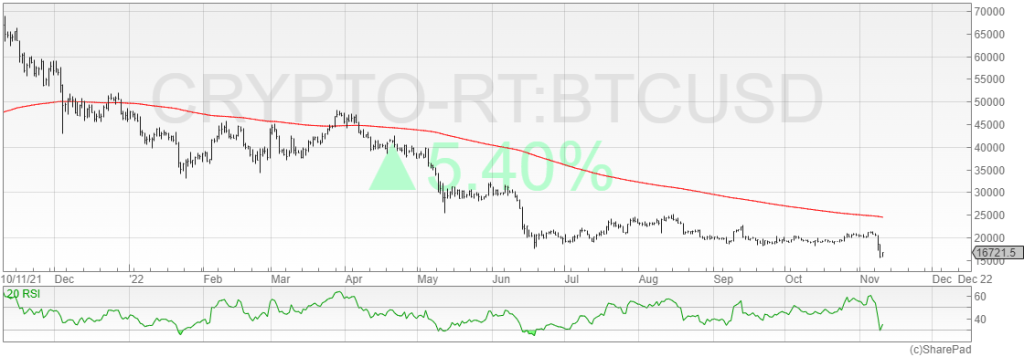
How things have changed in recent months! Just look at Bitcoin, the crypto currency which serves as reference for more or less the whole market: Just look at the chart below, Bitcoin has been mostly languishing at levels of between $17’000 und $25’000 since June – after having traded as high as $69’000 in November 2021. And other widely traded cryptos such as Ethereum, Tether, Cardano and Solana to name but a few haven’t fared any better.
But many more currencies have actually fared worse as far as trading activity is concerned. According to an article on Bloomberg.com, a staggering 12’100 tokens (that is 12’100 different crypto currencies) haven’t seen any trading activity in at least a month this year. To put this number into context, in 2020 there were 1’500 cryptos which weren’t traded in at least a single month, while the number rose to 3’700 in the bull-market year of 2021.
Accordingly fortunes which had been made have since been lost – entirely or at least partially: Sam Bankman-Fried, former CEO of the third largest cryptocurrency exchange FTX and at the tender age of 30 the world’s youngest billionaire with a fortune of some $22 billion in March 2022 has now lost all his wealth after he put his empire into bankruptcy on 11 November. And apparently the US Department of Justice and the SEC (the American stock exchange regulator) are looking into the collapse as this shouldn’t happen to an ‘exchange’. Changent Zhao, the co-founder and CEO of closely held Binance (another crypto exchange) has lost an even larger fortune since he debuted on the Bloomberg wealth index in January 2022 with a net worth of $96 billion, one of the world’s largest. By 8 November 2022 that pile had shrunk to $17.4 billion according to Forbes.
It seems that interest in crypto assets remains high, but in an environment of a growing number of regulations and oversights (too many people have lost too much money by unscrupulous market participants), it is difficult to predict where this market is headed in the long-term, but increased regulations should make the market ‘safer’ in particular for private investors. In the medium to long term, institutional investors will also increasingly look at alternative investments, not least in the crypto sphere, and this maybe not only as an investment but also as means of payment (since 2021, the Swiss canton of Zug accepts tax payments in Bitcoin and Ether) and a tool to fulfil smart contracts automatically (such as on completing the purchase of a house, for example).
Decentralised finance (or DeFi in crypto speak) is here to stay and in good time may well threaten the existence of traditional intermediaries such as banks and even lenders. But the technology is in its infancy, comparable with the early versions of the Internet in the 1990s (who remembers dial-up modems, Bulletin Board Services (BBS) and rudimentary chat rooms?). So this evolution will take time, but there can be no doubt that at some time in the future an Amazon or Google of the crypto world will emerge.
The difficulty then – as always – is to place your bet on the right token: Some will succeed, but some which look promising now will fail. And in the end it will be the market which will decide which crypto currencies are best suited for a given purpose. In crypto like with the videorecorder, it might not be the first mover which ultimately prevails: Sony brought the first VCR and with it the Betamax format to market in 1975, only to be ultimately uprooted by JVC, which a couple of years later invented the Video Home System (or VHS for short). The same could easily happen with crypto currencies, so an investment in crypto assets even at this level is probably nothing for the fainthearted. But like for the early investors in Amazon and Google, it might well be worth your while.
 The grumpy older man