
The announcement on 30 May was not quite unexpected I suppose: a New York jury found former president Donald Trump guilty of all 34 counts of falsifying business records. So the former and aspiring POTUS is now a convicted felon. This means, should he get re-elected in November, that the most powerful democracy in the world would be led by a convicted criminal.
Trump certainly wouldn’t be the first convict to become head of state (as were for example Nelson Mandela in South Africa, Bidzina Ivanishvili in Georgia or Anwar Ibrahim in Malaysia), but whereas the convictions of the other head of state were primarily politically motivated, Trump’s conviction is for a criminal offence and, whatever he may pretend, in my opinion this is not a means by his political opponents to prevent him from regaining the keys to the White House.
It is unlikely that Donald Trump will have to serve any time in jail (a maximum term of 4 years behind bars would be possible though), still one is allowed to wonder what kind of image this will convey should he be re-elected. It certainly won’t help ease tensions with Russia and China, nations which too aspire to global leadership roles – and which quite understandably will highlight that only under a flawed system of governance a convicted criminal can hold such a powerful position.
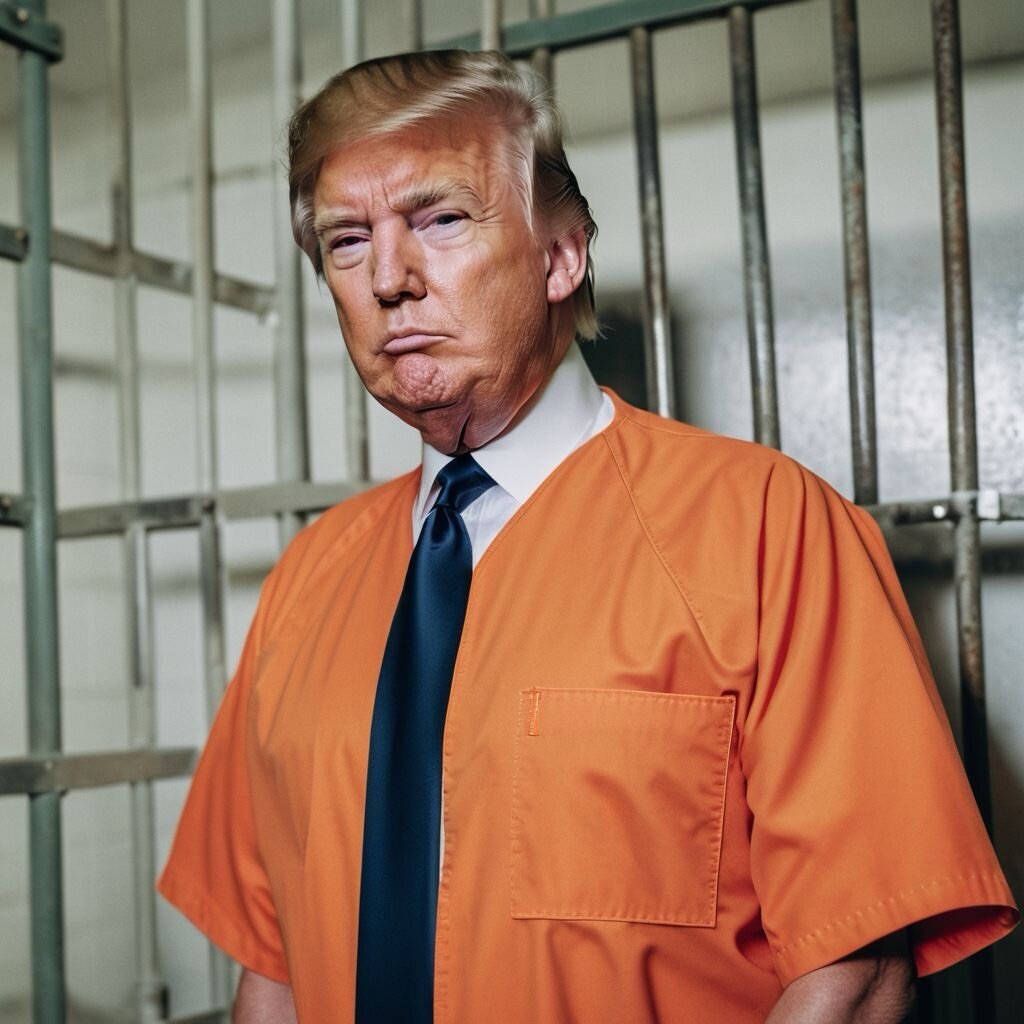
Interesting, should Mr Trump be re-elected, is going to be his international travels: Several countries have policies that restrict or ban the entry of individuals with criminal convictions. These policies can vary widely in terms of which crimes and what types of convictions result in entry bans and, admittedly, in most cases this is for more serious crimes than falsifying business records. But countries with restrictions include Canada, Australia, Japan and even the U.K. Will we ever see Air Force One being refused to touch down in a foreign land? Unlikely. Or, since even the U.S. restricts entry for individuals with certain criminal convictions, including crimes involving moral turpitude (e.g., fraud, theft), could the Commander in Chief be refused to return home?
Not that this would be a first: The Shah in 1979 left Iran for medical treatment and diplomatic visits amid increasing unrest. During his absence, the Iranian Revolution culminated in his overthrow, and he was not allowed to return. Or take Pakistan in 1999: Prime Minister Nawaz Sharif was abroad in Saudi Arabia for a state visit when General Pervez Musharraf, then Chief of Army Staff, led a military coup against him. Upon attempting to return to Pakistan, Sharif’s plane was initially denied permission to land.
So opponents of Donald Trump take note (and solace): Should he prevail in November, you could always take a leaf out of Iran’s or Pakistan’s book and prevent or at least stall his return when he’s on official business out of the country. Radical? Yes, definitely! But I fear that using his catch phrase ‘you’re fired’ from The Apprentice won’t do the job.
 The grumpy older man