
iPhones are expensive, even more so if the purchase is not subsidised by your mobile phone company, and a lot of the cost (especially if you pay the full price) is Apple’s profit margin: at present an iPhone costs in the region of $330 to produce.
The supply chain for a typical iPhone is vast and global, involving numerous countries across multiple continents: the USA (design, software, chips, glass for screens), China (assembly, component manufacturing), South Korea (display panels and memory), Japan (camera components and other electronics), Germany (chips and sensors), India (increasingly alternative location for assembly), Vietnam (components and accessories). So it is no surprise the president Trump’s new tariffs will wreak havoc as far as the cost of components let alone the end price of an iPhone and most other electronics is concerned.
Far from revitalising American industry, these tariffs are likely to push up prices for consumers, strain international trade relationships, and destabilise global supply chains. Worse still, they won’t deliver the promised manufacturing resurgence, at least not in any meaningful or immediate way.
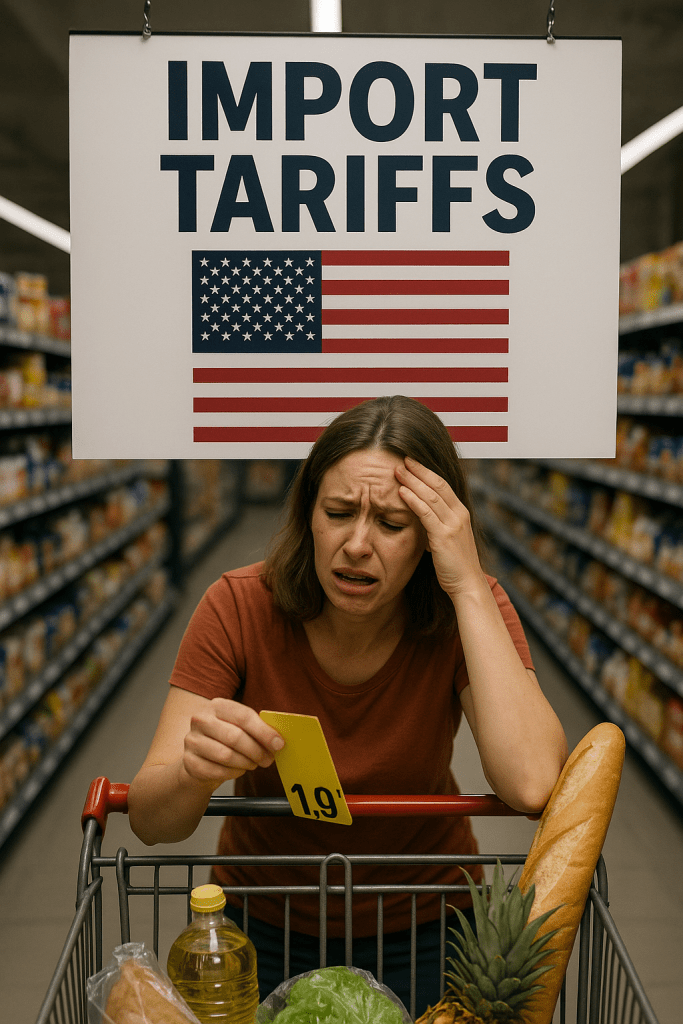
Tariffs are, at their core, taxes on imported goods. Though they are technically paid by U.S. importers, the cost is quickly passed on to American consumers through higher prices at the till. Trump’s current 10% blanket tariff will effectively act as a sales tax on almost everything, from smartphones and TVs to clothes, food. And even medicines won’t be spared, as new tariffs on pharmaceutical products are looming as well.
The consequences are not theoretical. During Trump’s first presidency, studies by the U.S. Federal Reserve and various economic think tanks showed that tariffs imposed between 2017 and 2020 directly led to price increases for American consumers. For example, tariffs on steel and aluminium raised costs for U.S. manufacturers, which then passed those costs on to buyers—whether they were purchasing a new car, a washing machine, or a tin of soup. Or a new handbag: French luxury brand Hermes just announced that it would be fully passing on the added costs to its customers.
Now, with tariffs being threatened on virtually all imports, the price hikes could be even more severe. This kind of across-the-board protectionism will burden not just households, but also small businesses that rely on imported goods to stay competitive.
The U.S. remains the world’s largest importer, and any shift in its trade policy has seismic effects globally. Countries that rely on exporting to the American market such as Germany, Japan, South Korea, Mexico, and especially China are already bracing for a hit.
Trump’s current 125% tariff on Chinese goods is particularly aggressive and risks reigniting a full-blown trade war. In his first term, tit-for-tat tariffs between the U.S. and China led to billions in losses for American farmers and exporters, prompting the federal government to step in with emergency subsidies. There is little reason to believe round two would end any differently.
Retaliation is already being discussed in capitals around the world. The European Union, Canada, and China are all exploring countermeasures. If trade becomes a political battleground once again, the fallout could extend far beyond bilateral tensions, disrupting global supply chains and pushing economies closer to recession.
Tariffs don’t just impact finished goods, but also the components that go into them. U.S. manufacturers, far from being protected, often find themselves paying more for the materials they need. This undercuts their ability to compete and discourages long-term investment. And with every single country being hit by the new tariffs shifting operations to lower-cost countries is hardly an option while reshaping supply chains to setup manufacturing plants in the USA takes years, not months.
One of Trump’s central claims is that tariffs will bring back American manufacturing jobs. In reality, tariffs alone are unlikely to achieve this—and certainly not on the timeline or scale he promises.
First, manufacturing in the U.S. remains far more expensive than in most parts of Asia. Labour costs, regulation, and infrastructure are all major hurdles. Even if firms do return production to U.S. soil, many of those jobs will be automated. Advanced manufacturing techniques and robotics mean factories simply don’t require the same number of workers as they did decades ago.
Second, policy uncertainty is bad for investment. Companies are less likely to open new plants in the U.S. if they suspect future policy swings or retaliatory tariffs that could affect profitability. A more stable, rules-based trade environment encourages reshoring far more effectively than blunt-force protectionism.
Trump’s renewed trade agenda may win applause at rallies, but it risks plunging the global economy into a new period of instability. For American households, the most immediate impact will be higher prices on everyday goods. For businesses, it’s more expensive inputs and uncertain investment conditions. And for trading partners, it’s a direct economic threat that may provoke retaliation and deepen global divisions.
Rather than reinvigorating U.S. industry, these tariffs could isolate the country from the very supply chains it helped build. In an increasingly interconnected world, economic nationalism doesn’t build resilience—it often undermines it.
If history is any guide, Trump’s tariffs will end up being a burden shared by consumers, businesses, and economies far beyond America’s borders.
So back to the iPhone I started out with: if it were manufactured entirely in the USA, at a hypothetical tariff level of 60% and assuming the same kind of margin for Apple as before the trade war, the device would have to retail for roughly $3500 a piece. Not sure many people would be able to let alone want to fork out this kind of money for a mobile phone (albeit a very sophisticated and powerful one). As a direct consequence of the tariffs we all risk ending up with less money at the end of the day in our wallets.
 The grumpy older man
A very good and informative read that every American should read and try to understand.
LikeLiked by 1 person