
You probably won’t remember my post about Bitcoin on 8 January 2020. I concluded with the statement made by John McAfee (yes, the John McAfee of the famous antivirus software) in 2017 that by the end of the year 2020 one Bitcoin would be worth 1 million Dollars. Well, it hasn’t happened and I am sure Mr McAfee could rightly or wrongly blame the Covid-19 pandemic for it, since more time spent in home offices and the very generous American compensation cheques motivated many people to play the financial markets and crypto-assets.
Nevertheless it is interesting how the fortunes of Bitcoin have evolved over the past 12 months. And it is very likely that the pandemic has played a role in it.
Up to the end of 2019 Bitcoin was mostly known to geeks and speculators, and no serious investor, let alone an investment fund, would have even thought about investing into cryptocurrencies. 12 months on and highly respected hedge fund managers such as Paul Tudor Jones have a low single digit percentage of his multibillion hedge fund allocated to Bitcoin. And it should’ve been worth his while: In just 12 months has the price of one Bitcoin gone from some $7500 to an intraday high of over $41000 in early January 2021. A JP Morgan strategist even sees a long-term target of $146000 per bitcoin. I for one am and remain a sceptic.
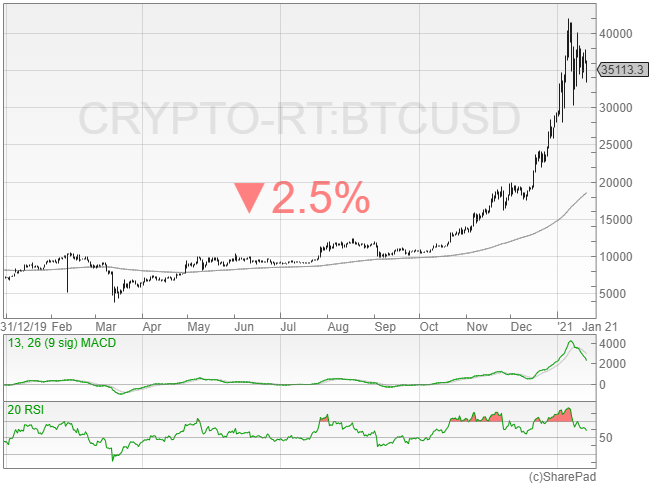
Certainly one reason for the appeal of Bitcoin is the finite number of 21 million coins that can be mined. This creates a level of scarcity. To date some 18.5 million have been mined, 40% of which are said to be held by a small number of investors. This leaves some 11 million coins freely circulating. While some institutional investors have now moved in on the action, I suppose it is still fair to assume that most trades are made by individuals, most of which are more likely of the speculating kind, eager to make a quick buck rather than long-term commitments.
Another problem with bitcoin is that there’s no tangible way to value it as an asset. With stocks and shares you can examine balance sheets, listen to company executives’ presentations and read analysts’ research notes, but with Bitcoin there is no tangible information to wrap your head around. And there is no regulation: Investments in Bitcoin in its original form (rather than through regulated investment products offered by asset managers) are not protected if the exchange that holds the coins is hacked (anyone remember the Mt Gox hack in 2014?). Accordingly UBS, a Swiss bank, and Britains regulator, the Financial Conducts Authority (FCA) recently warned that investors in cryptoassets and related instruments or schemes should be prepared to lose all their money. The risks for investors are also blatantly obvious from last month’s demise of another Bitcoin trader, South Africa based Mirror Trading International, holding alledgedly $880 million worth of Bitcoins for its customers.
In a recent paper Alex Pickard, Vice President of Research at Research Affiliates warns that Bitcoin is neiter a capital asset nor a store of value and that ‘the price of BTC is nearly certainly a bubble and likely manipulated’ in conjunction with Tether, another cryptocurrency. Pickard and others allege that one large trader issues unbacked Tether-coins which are then swapped against Bitcoins, pushing the price of Bitcoin higher in the process. Tether has been under investigation for fraud since 2019 by the New York Attorney General and has admitted that it is only backed by 74 cents on the Dollar. When in 2018 1 billion Tethers were redeemed, Bitcoin’s price dropped by 50%. Just a coincidence? I leave it to you to decide.
As Pickard states in his paper, Bitcoins are also a very unwieldy payment tool: The system only allows some 350’000 transactions a day while over 7 billion people need to buy goods and services daily. And even the ‘inflation hedge’ argument doesn’t hold, since in 2018 the price dropped by over 80% while 5-year inflation forecasts were firmly anchored at around 2%.
I do dabble in stocks and shares, not always successfully I hasten to say, but I simply do not understand the appeal of cryptoassets. Younger readers may find that this goes with my age and being a grumpy old(er) man. But then I am not going to make a promise such as John McAfee did back in 2017, when he said that he would eat an intimate body part if Bitcoin did not trade at $1 million by the end of 2020.
Anybody have any information on whether Mr McAfee made good on his promise? No video evidence needed though.
 The grumpy older man
Well, I read this again. I’m a grumpy old sommich, too (surprise, surprise!) but reasonably well-away from being a Luddite or technophobe, yet I cannot buy into any part of the Bitcoin bullship. Here, we look to be be and with COVIS-XX are discouraged from cash use. Stop and think (you too, kiddies) about this incessant push to make us a cashless society. Not a bad Idea you say? Try this on: for a stick of gum you’ll have to use the nth generation “cashless” payment method. It will be tracked. Uncle Charlie (or Uncle Boris) knows how much “money” you bandy about, so he looks to see that he is getting his disproportionate share. He’ll find you (easy-peazy) and squeeze your balls until he gets what he wants. Barter system? Yunh, to a very limited extent, but with CCTV everywhere Uncle BJ and Uncle Sleepy/Sleazy will exact their due when you trade that broken down sofa for a 1968 issue of Mad Magazine. Nope. I hope Bitcoin hits a million per and promptly falls into a dark web abyss. The whole concept is wrong and meant only for its creators and lower granite blocks in the scheme to enrich themselves for doing nothing. I hope all purveyors of bitcoin and other social ship-schemes die of syphilis.
LikeLiked by 1 person
I couldn’t agree more! In my humble opinion bitcoin is just one of these things which are best left alone (or left to those who are at leisure to spend all day long in front of their computer screen, watching price movements and following charts). You are spot-on as well as far as cashless payments and government ability to monitor our spending is concerned. No more paying my local builder in cash so I can avoid paying the VAT. Do you remember, I think it was a couple of years ago, when the Indian government decided to withdraw the most commonly used banknotes? Almost overnight the economy basically came to a standstill. So, as you rightly point out, the more we do online the more Big Brother (or uncle) is watching us. In the meantime let’s just feel sorry for all the poor sods who purchased bitcoins ages ago but can’t now remember the passwords to access them again….
LikeLiked by 1 person