
Elon Musk has told Twitter staff that they must commit to working “long hours at high intensity” or else leave the company, according to reports. And that is after Mr. Musk already sacked half of Twitter’s employees – only to hire some of them a couple of days later after finding out that some of them were crucial to the future development of the platform. And when you fire your staff by the thousands, it is quite impractical to have a chat with every single one of them, so everyone just had to anxiously wait to find out whether they were sent their dismissal by email (it seems that some people found out even before they received the email by finding that the access to their systems had been revoked). But not only the number of employees has been drastically reduced, Musk on 13 December also liquidated Twitter’s ‘Trust and Safety Council’, a group consisting of members of human rights and youth protection organisations whose role it was to advise the platform on the further development of products and rules.
In most developed economies and industries there are currently two job openings for every unemployed worker. Baby boomers reach now retirement age (so will I in a few years) and as a consequence employers are desperately looking for experienced staff. In this context Mr. Musk’s attitude to employees is surprising to say the least and as a consequence he also fits all the criteria, at least in accordance with an article published in Forbes magazine in 2014, of a bad boss.
AT Kearney, a consultancy, in 2018 conducted a survey that explored the degree of joy employees experience at work (yes, you may not believe it, but it is actually possible to enjoy work) and the results were quite interesting, confirming that joy stems from believing one’s work is truly meaningful. Almost 90% of respondents stated that they were expecting to experience a meaningful degree of joy at work, yet only 37% reported that they were actually experiencing such satisfaction, leaving a ‘joy gap’ of 53%.
The survey highlights what really makes employees happy at work: Understanding and then feeling committed to achieving the company’s vision and strategy as well as believing that the business makes a positive contribution to society were the principal drivers. And that isn’t really surprising, as a vegan will probably struggle working for a butcher and an environmentalist may find it challenging working for an oil producer, whereas whether Twitter makes a positive contribution to society remains debatable.
The next drivers in the AT Kearney survey are somewhat more personal: People want to work for businesses where successes are celebrated with in the team, where they feel a strong bond within the team and where their talents are being used effectively. Making threats to your personnel such as Elon Musk did mid-November when he set the ultimatum to buckle-up or leave the company clearly doesn’t pass that test. According to news reports hundreds of staffers did indeed not accept the challenge and hence found themselves made automatically redundant with three months severance pay. The departures highlight the reluctance of some of Twitter’s 3’000 or so remaining employees to stay with a company where Musk earlier fired half of the workforce including top management and is ruthlessly changing the culture to emphasize long hours and an intense pace.
The heat is on at Tesla as well: A leaked email which Musk had sent in the spring to his executives states that “anyone who wishes to do remote work must be in the office for a minimum (and I mean minimum) of 40 hours per week or depart Tesla. This is less than we ask of factory workers,” adding that the office must be the employee’s primary workplace where the other workers they regularly interact with are based — “not a remote branch office unrelated to the job duties.” Musk further said he would personally review any request for exemption from the policy, but that for the most part, “If you don’t show up, we will assume you have resigned.”
It is common sense that happy workers are productive workers, and a positive atmosphere in the workplace makes for more enthusiastic and customer oriented colleagues. Fair enough, most users of Twitter will never need or want to interact with a human being at the company, but some may wonder whether they want to use a social media platform provided by a man who treats his employees in such a manner.
I notice a distinctly authoritarian streak in Elon Musk: Not only in how he treats his employees (and without them, I suppose, there is not going to be much left of Twitter as it is no doubt not going to be the big boss himself who will program algorithms etc), but also his idea of free speech is somewhat lopsided. After He readmitted Donald Trump to Twitter again, it has transpired over the past few days, that on the other hand he suspended the accounts of a number of independent journalists and researchers for expressing critical views of Twitter.
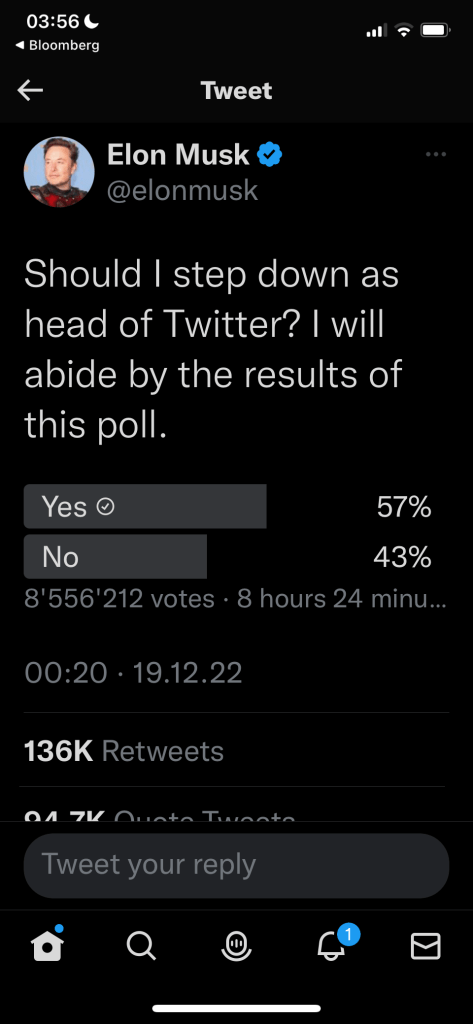
As I am in the process of finalising this post, Elon Musk has posted a poll asking his followers whether he should step down as head of Twitter. By the time I cast my vote, some 8.5 million followers had already expressed their opinion and it seems that the end result in percentage terms remained the same with in the end some 17.5 million votes cast.
Mr. Musk in the meantime has converted empty offices and conference rooms at its San Francisco headquarter into rest areas – complete with mattresses and bedside tables in an effort to help “tired employees” at the company. Some may indeed be tired in the literal meaning of the word, some more may equally be tired of their big boss.
 The grumpy older man
I think you’re right. With tech firms, the property is all intellectual. Who has the most – the person with 100% of the shares, or the person who knows the ins and outs of how the company operates, who can take that knowledge and apply it to something else in a hertbeat?
LikeLiked by 1 person
I suspect that in tech firms it’s the latter (i.e. those who knows the ins and outs and how the business operates), and I think it’s also these people who potentially leave a company in a heartbeat to apply their knowledge to something else. A typical example here is again Elon Musk: A number of observers and shareholders of Tesla criticise his focus on Twitter (and hence a degree of neglect at Tesla), which may at least in part be responsible for the recent fall in Tesla’s share price. Even big shots like Musk can only focus on so many issues at one time and hence run the risk of dropping a ball or two while juggling too many responsibilities….
LikeLike
I think, whatever happens within Twitter, there’ll be a knock-on effect (good or bad) in the value of the company. But of course, we won’t see that because it is now owned privately. If Musk handles this badly, Twitter could conceivably be worth nothing.
LikeLiked by 1 person
I have to agree with you again on this one! And I think Musk knows that full well since he paid top money (probably actually too much) for the company
LikeLiked by 1 person
That’s the surprising thing. Somebody like Musk, I think, would only have bought Twitter if he thought he would make money. At least, that’s what I think. If he thought he’d make money he’d have invested in three-legged donkeys!
But these moves seem to put him in the league of the old-fashioned newspaper mogul, who doesn’t care whether they lose money, just so long as they have their mouthpiece.
Dunno. Maybe he is so rich, that is indeed the case? Don’t you think it’s strange, though?
LikeLiked by 1 person
I really don’t know, but all the hype and tweets by Musk initially about him buying the company may well have been meant as a joke or teasing some reaction from his audience. Quite honestly they never made sense to me but just take a look at his tweets about crypto currencies (at least when that market was booming), and I am not sure whether he was really that serious about them or just having some fun… I wouldn’t even put it past him (maybe wrongly so!) that he sets off these tweets BECAUSE he know of the impact he has…. As far as Twitter is concerned, however, I don’t think he did his due diligence: Anyone seriously financially minded would have taken a look – and walked away. At least that’s what I think. But then, as you point out, maybe he thought that with his immense fortune (well, a bit lese immense now) he could buy whatever he wanted? Your guess is as good as mine….
LikeLiked by 1 person
I agree. It did seem a strange decision. Fron the outside, he is wanting to increase revenue. Which means increasing revenue per user, or increasing users, i.e. growin the platform, presumably by making it better. By all accounts, people are up in arms about what he is doing.
I don’t pay much regard to this poll; it is 20M users of 230M. But surely it is indicative? Or does he just assume that the other 200M are happy? Dunno.
LikeLiked by 1 person
Well, he said that he would abide by the poll…. now let’s see! He hasn’t tweeted anything since as far as I know, so maybe he is having second thoughts? But in any case I am not sure that he is the right person to push the platform forward.
LikeLiked by 1 person
he might well interpret the result as, “200M people are satisfied with me at the helm, so did not bother expressing their opinion in the poll”.
I’m kinda interested purely as a bystander since I don’t use the platform. I’m interested how it generates its revenue currently, since obviously it it “free” to use. What made it worth all that money? I guess they must show adverts / sell data… but that’s a lot of data!
LikeLiked by 1 person
I do use Twitter every now and then and indeed I suppose it’s the adverts or sponsored tweets which pay for its upkeep. Would I pay a subscription fee for not to be bothered with adverts? No, definitely not – and I suppose that goes for a majority of ordinary users. So personally I don’t quite see how Twitter can become that big revenue generating machine Musk seems to expect (or hope) it to be.
LikeLiked by 1 person
I suspect everybody would say the same as you. For a service which is currently “free”, why should users start paying?
LikeLiked by 1 person