
5 December 2022 marked the 70th anniversary of the Great Smog of London when a period of unusually cold weather, combined with an anticyclone and windless conditions, collected airborne pollutants—mostly arising from the use of coal-fired heating—to form a thick layer of smog over the city. It lasted from Friday 5 December to Tuesday 9 December 1952.
The smog caused major disruption by reducing visibility and even penetrating indoor areas, far more severely than previous “pea-soupers”. Government medical reports in the weeks following the event estimated that up to 4’000 people had died as a direct result of the smog and 100’000 more were made ill by the smog’s effects on the human respiratory tract. More recent research suggests that the total number of fatalities may have been considerably greater, with estimates of between 10’000 and 12’000 deaths.
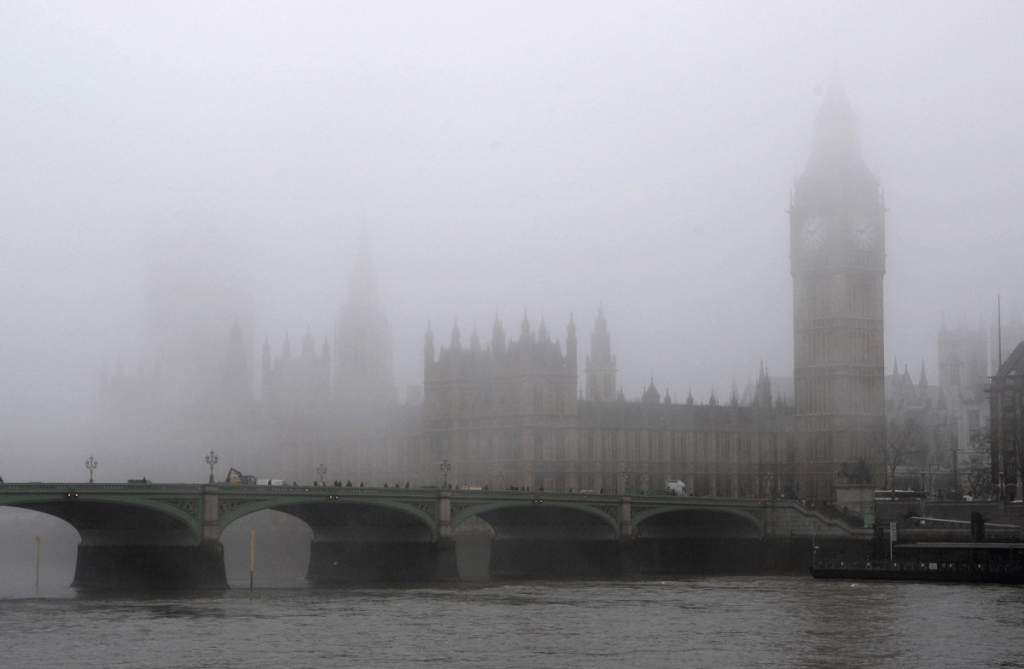
But while burning of wet wood and coal in homes in Britain has been banned since May 2021 and the deadline to phase out all coal from Great Britain’s energy system has been brought forward by a whole year to 1st October 2024, smog remains a big problem in many developing nations and their cities: In early November, India’s capital Delhi recorded an average air quality index (AQI) score over 600, well in excess of the 300 classified as ‘hazardous’ on the international AQI rating system (as of 31 December, the score for Delhi had dropped again to an ‘unhealthy’182).
Other cities are faring even worse: Leading the rankings on the last day of 2022 is Dhaka, the capital of Bangladesh, with a very unhealthy score of 220 with PM2.5 particles (PM2.5 refers to atmospheric particulate matter that have a diameter of less than 2.5 micrometers, which is about 3% the diameter of a human hair) at a concentration of 33.7 times the WHO annual air quality guideline value. In 2nd place is the Chinese city of Wuhan with 193. Even Qatar which just hosted the football world cup scores 157 in its capital Doha on this specific day. At the other end of the scale there are obviously places with clean air: On 31 December these were places such as Prague, Salt Lake City, San Francisco, Sidney, Seattle and Berlin. And even London managed a very decent score of 21. The full and daily updated ranking can be found here.
One of the purposes of the UN Environment Programme (UNEP) is to “explore the state of air pollution, what’s happening now, sources per sector, policy actions, current gaps and what needs to be done to address the pollution emergency”. In reducing our contribution to air pollution we can all help improve air quality and at the same time reduce global warming and climate change. And small steps can have big results when multiplied, such as demonstrated by the butterfly effect in chaos theory.
A lot has happened since the fateful December 1952, but while smog may no longer be a major problem in London (or anywhere else in the developed world), as the AQI ratings show, this is not the case in the developing economies. Air pollution at the moment is responsible for 1 in 9 deaths worldwide and hence it is time that we all make our small contribution towards a better future for our children and grandchildren.
 The grumpy older man
That;s a tricky one, especially with the recent cold snaps in the UK. It’s still posible to buy coal, and it burns warmer than e.g. wood. They say it is now smokeless, but it must still emit something. Even wood emits. I get away with it because I am rural. I won’t addect air quality.
LikeLiked by 1 person
I know, given the current situation this really isn’t an easy one, and even Germany is switching back on it’s coal fired power stations. I suppose for this winter and next we will have to live with that (and climate change / global warming) may temporarily have to take a back seat)… but then again, I suspect in most emerging economies it is mostly industrial plants which are to blame for the noxious outputs….
LikeLiked by 1 person