
After a number of years of some calm, the Middle East has erupted again! On October 7, Hamas fighters, invaded Israel, killing scores of civilians and taking many more hostage, with Israel retaliating, killing more innocent civilians, this time, Palestinians in the Gaza Strip. Things have since gone from bad to worse, with scores more of Palestinian civilians being killed and a majority of the population namely of the northern half of the Gaza strip having been displaced to the south.
I suppose one can disagree on whether Hamas is a terrorist organisation or not (personally I think they are) and whether the Israeli response is appropriate, in particular withholding humanitarian aid from an already massively challenged and destitute civilian population in the Gaza Strip. (I think it is wrong).
So the current situation raises once again the question of what should be happening next. Many of us will remember the Oslo accords of 1993 and namely the proposed two-state solution. 30 years on nothing has come from the agreement and the current political, military and economic situation (the latter for the Palestinians only) is worse.
And still there’s hope: Under the Abraham accords some of the gulf states have in recent years normalised their relations with Israel and, at least from what I am reading, many of the Arab governments are fed up of Hamas‘s violence. In Israel the government under Benjamin Netanyahu is split and doesn’t have the unlimited backing of the population, while Netanyahu himself faces legal proceedings for bribery, fraud and breach of trust.
A two-state solution is still the best outcome to stabilise the Middle East, providing security guarantees to Israel and their own territory to the Palestinians. However, this also requires a change as far as the parties involved are concerned: Hamas is a terrorist organisation, which hardly represents the true interests of the Palestinian civilian population (although a majority of Palestinians are still backing them), and the Palestinian Authority (PA), which governs the West Bank is a feeble and nowadays non-functioning body under the de facto leadership of Mohammad Abbas. And, as stated above, Netanyahu’s right wing government needs to go once the war in Gaza is over.
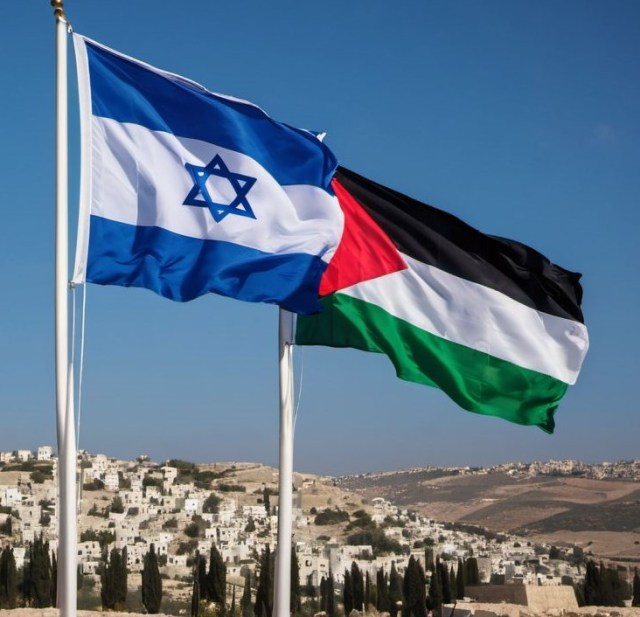
The present governing authorities in Israel and the Palestinian Territories are unsuited for a number of reasons to be part of the negotiations towards peace and a hopefully lasting solution giving the Palestinians their own state. A new leadership team led by pragmatic and credible people needs to be put in charge of the occupied territories and Israel needs to be governed by politicians who understand and respect what is at stake for all parties involved (and that includes the Palestinians). Israel’s Ambassador to the UK’s comment that a two-state solution was not an option once the fighting in Gaza ends is unhelpful to say the least. But then again, it is unlikely that the current right-wing Israeli administration will stay in power after the hostilities. I dare assume that a majority of the Jewish population in Israel crave stability and even more importantly security in their homeland, and they would be aware that this cannot be achieved by the present administration and without some sort of compromise.
A lasting solution is unlikely without some meaningful mediation. The USA’s reputation in that respect is tainted by the pro-Israel lobbying and then vetoing a cease fire at the UN Security Council. However, since the thawing of relations between Israel and a number of Arab nations under the Abraham accords, countries such as Egypt, the UAE and Saudi Arabia (the Saudis have yet to normalise their relations with Israel) are well placed to lead negotiations and fulfill the role of peacekeepers in the Region.
If that were to happen, what was started 30 years ago with secret talks in Norway may finally come to fruition. And so at least some good would have come from the atrocities committed on and since 7 October.
 The grumpy older man
I don’t think there’s any good to say about any of them – Hamas, Israel or the USA. And it’s the Palestinians who suffer.
It’s probably best I stop there.
LikeLike