
AI as in artificial intelligence is all the rage these days, isn’t it. Any service assisted by AI is novel – and the company which provides it finds itself no doubt at the cutting edge of technology. At least until someone finds out that all is not what it seems.
You may have heard of Amazon’s shops without tills, where the items are automatically registered for payment as soon as you pick them up and put them in you bag: it seems that Amazon is closing the shops because the technology is not working. The supposedly revolutionary technology that enabled supermarket shopping without a cash register was in reality less based on artificial intelligence, but mainly on the fact that more than 1000 workers from India monitored customers by camera when shopping and booked all goods by hand. So AI in this instance stands for ‘Actually Indian’.
And that’s not the only instance: OpenAI, the company behind the language AI ChatGPT, and other technology companies now employ tens of thousands of people in low-wage countries – including in Africa. In Kenya, for example, and Uganda, an entire industry has emerged from companies that provide AI companies with employees for the training of AI models. Amazon itself operates the “Mechanical Turk” a platform for the placement of tasks that only human employees can fulfil. These are often simple tasks, such as providing images with descriptions for training AI models. Most workers come from emerging or developing countries. And there are often complaints about poor or completely missing pay.
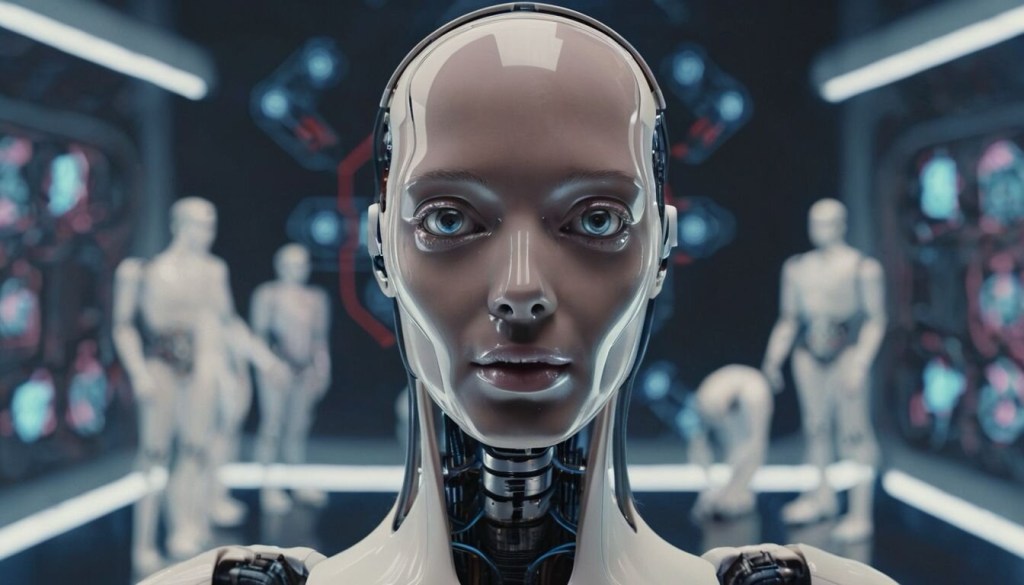
In some cases, however, the activity of human employees goes far beyond the training of AI models. Last year, the startup Kaedim caused a stir, which, according to its own information, had developed an AI-based technology that could convert two-dimensional images into three-dimensional models. In fact, a significant part of this work was done by human employees who were deployed around the clock in different countries. According to a report by the technology portal 404 Media, they had to create models within 15 minutes to maintain the impression of an automated process.
In another prominent case, the company Kiwi-Bot gave customers in the USA the impression that their delivery vehicles, called robots, were driving autonomously. In fact, employees in Colombia steered the small vans with food orders or other deliveries by camera. This was probably not only the more reliable solution, but thanks to an hourly wage of two dollars probably also the cheaper one, compared to an autonomous vehicle control.
These are just a number of instances where human rather than artificial intelligence is applied to solve a problem, either because the technology simply is not up to scratch (yet) or because humans are cheaper. But then there is the other extreme, where maybe less artificial intelligence but more of the human kind would be desirable, such as the apparent use of AI by the Israel Defence Forces (IDF) of late in Gaza: Tools known as ‘The Gospel ‘ and ‘Lavender’ are used to mark operatives of Hamas and Palestinian Islamic Jihad as targets for bombing. The sources claim that the algorithms have been used to create “assassination factories” in which the homes of thousands of Hamas members, including junior ones, are marked down for air strikes, with human officers providing merely cursory oversight (the IDF dispute this interpretation and state that the AI tools are “neutral”, used only for solving problems in managing big data, and do not replace intelligence officers, who view the relevant material and reach a decision).
Clearly it’s early days for everything Artificial Intelligence and right now I suspect many firms use the term ‘AI’ in relation to their products and services simply to make them appear more sophisticated than they really are – and to be able to charge more. But there is already evidence of AI making a difference, such as in call centres where handlers are assisted by AI are seen to provide better service to callers while being more efficient at the same time. In the meantime AI is already integrated into many aspects of daily life, such as online shopping recommendations such as on Amazon, social media algorithms, which make us see more of the kind of posts we‘re frequently looking at and thus further underpinning the concept of confirmation bias, virtual assistants like Siri or Alexa, email spam filters, navigation apps, and even some aspects of healthcare like medical imaging analysis (although some of that is also done by humans in India.
The cost of training ever larger Large Language Models (LLMs) is bound to substantially increase unless new ways of crunching the data can be identified. Training ChatGPT 4 cost in the region of $63 million, whereas GPT 5 is going to cost $2 to $2.5 billion. This is on one hand due to the fast growing amount of processing power required, as well as the exponential increase in energy the necessary data centres consume. So, for a while yet, humans may actually be the cheaper and maybe even more reliable alternative to artificial intelligence.
 The grumpy older man
I think you’re abso;ute;y right. I was a part of the dotcom bubble, and have read the history of many bubbles before it, and this feels much the same. Considering the enormous potential of AI, I seem to hace many poor experiences with it, so it isn’t there yet.
Plus, of course, when it is used for customer service, companies fire their humans, the AI isn’t up to scratch, so their customer service actually gets worse.
LikeLiked by 1 person
I am sure AI will have it’s time and will make life and work in many ways easier, but we’re not there yet.
You make an excellent point with customer service: have you ever used some of the chatbots on for example some high streets banks’ websites? Some of them are so utterly useless, I wonder how they even had the idea to go live with them…
LikeLiked by 1 person
I’m fortunate with banks that I can do it all online. But I did contact Logitech about somewthing and got no sense at all from their support bot, just ended up being transferred to a human, and everything takeng 10 minutes longer than it would otherwise have done.
LikeLiked by 1 person