
Some 45 years ago I trained as a banker in Switzerland and quickly became interested in the stock markets, which led me to work for some two decades as a trader for a Swiss private bank in Geneva and London. What a glorious time this was! There weren’t nowhere near as many regulatory restraints as there are today and markets were much more transparent.
Nowadays, besides the regulations and the lack of transparency due to dark pools (private trading venues where large buy and sell orders can be matched without displaying those orders to the public market beforehand) there is also AI to contend with.
Many private and institutional investors still rely on advice by their investment manager, often a middle aged man with decades of experience in analysing brokers‘ stock reports and analysing companies‘ balance sheets. Increasingly they now rely on artificial intelligence to summarise reports and examine data, but apparently a growing number of Gen Z investors now trust AI to structure portfolios and assist with their stock picking.
I gave it a try myself earlier this year when I had some cash to invest by giving ChatGPT a try to help me with my asset allocation (very conservative, low risk, regular income in Pounds Sterling and Swiss Francs, the currencies I mostly use).
With a few prompts I obtained a list of ETFs (exchange traded funds) with the respective amount in Swiss Francs and Sterling for each to invest in. Since yields in Swiss Francs at this moment are much lower than those in Pounds (0.1% v 4%), I decided to be slightly more aggressive with the Swiss portion of my portfolio by selecting a couple of high-dividend equity ETFs (with an average return of between 4% and 7%) while on the other hand keeping this portion of the overall portfolio much smaller than the Sterling part for which I invested in a couple of suggested Sterling corporate bond and gilt funds. The investment products were suggested by ChatGPT, but I did my own research on the back of the recommendation before placing the order. And obviously the more precise your prompt, the better the output.
In the process I couldn’t help wondering, whether asset management was another profession to be outsourced to AI at some point in the future, as it is already happening to coding and a lesser degree of law. Fund managers are to a degree biased towards their own favourite investment products and strategies. How about a supposedly neutral advisor who can digest all the information on any stock, bond or fund out there?
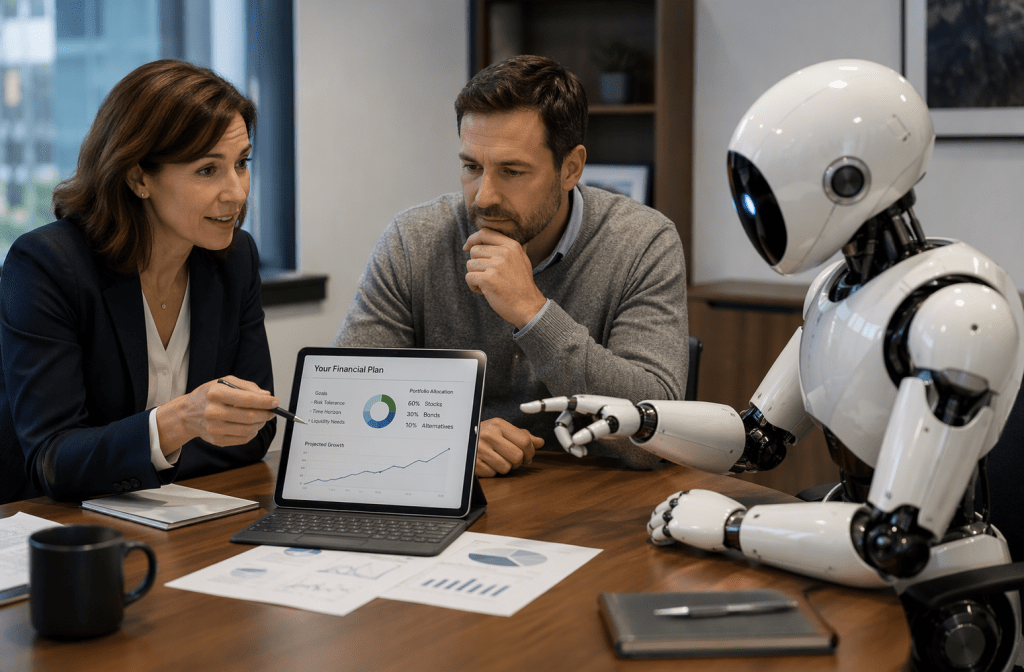
The promise of AI investment managers—often packaged as robo-advisors or algorithmic asset managers—has become one of the most compelling narratives in modern finance. At first glance, the proposition feels almost inevitable: machines that process vast data at speed, free from human emotion, and operating at a fraction of traditional costs. Yet, like most technological revolutions, the reality is more nuanced. Whether AI managers will prevail is not simply a question of capability, but of trust, context, and the limits of automation in uncertain environments.
The strongest argument for AI investment managers lies in their structural advantages.
First, cost efficiency. Traditional wealth management is famously expensive, layered with advisory fees, transaction costs, and operational overhead. AI systems compress this dramatically, enabling portfolio management at near-zero marginal cost. For retail investors—historically priced out of personalised advice—this democratisation is transformative.
Second, scalability and speed. AI systems can analyse thousands of securities, macroeconomic indicators, and alternative data streams simultaneously. Where human managers focus on selective insight, machines embrace total information coverage. In theory, this allows for faster reaction to market shifts and more diversified portfolios.
Third, emotional neutrality. Human investors are notoriously prone to bias: overconfidence, loss aversion, herd behaviour. AI, at least in design, is immune to panic-selling or hype-driven buying. It executes strategy with discipline, which can be particularly valuable in volatile markets.
These advantages suggest a clear trajectory: for standardised, long-term investment strategies—think retirement portfolios or passive allocation such as in my case—AI is not just competitive, but often superior.
However, what makes AI powerful also introduces its greatest risks.
The most immediate concern is opacity. Many AI-driven strategies operate as “black boxes,” where even their creators struggle to fully explain decision pathways. In finance, where accountability and regulatory scrutiny are paramount, this lack of transparency is problematic. Investors are being asked to trust outcomes without understanding processes—a reversal of traditional advisory relationships.
More critically, AI systems are only as good as their training data. Financial markets are shaped by rare, unpredictable events—crises, policy shifts, behavioural shocks—that historical data may not adequately capture. When confronted with genuinely novel conditions, AI models can fail abruptly, sometimes amplifying instability rather than managing it.
There is also the issue of systemic risk. If large numbers of firms deploy similar AI strategies, markets may become more correlated, increasing the likelihood of sharp, synchronised movements. Ironically, the efficiency of AI could reduce market resilience. But automated trades already were a problem before AI, when on 6 May 2010 the Dow Jones Industrial fell by 9% within minutes on the back of large automated sell program in stock-index futures (the market largely recovered quickly). Or think of the COVID-19 market meltdown in March 2020, when trend-following systems, risk-parity funds, volatility-targeting strategies, and automated risk controls accelerated selling.
As I see it, the likely future is not replacement, but stratification. AI investment managers will dominate where the problem is well-defined, repeatable, and cost-sensitive. Passive investing, asset allocation, and basic portfolio optimisation are already shifting decisively in this direction. For these use cases, human intervention increasingly looks like an expensive redundancy.
However, human managers retain advantages in areas where ambiguity and judgement matter, such as interpreting geopolitical developments, navigating regulatory changes, making conviction-based, concentrated bets or communicating trust and reassurance during crises. In essence, humans do not compete with AI on calculation—they compete on narrative and context. At least for now, the human brain still beats AI at conceptualising.
The real barrier to AI dominance is not technological but psychological. Investing is not purely an optimisation problem; it is also an exercise in trust. Clients do not just want returns—they want to understand why decisions are made, especially when things go wrong. AI excels at finding the best returns but struggles with explanation. Until that gap is bridged, full replacement of investment professionals remains unlikely.
And as far as my investments are concerned, I am still happy with the recommendations I got from ChatGPT back in February (some minor depreciation in value due to the war in the Middle East notwithstanding). Considering what professional investment advisors charge for their services, I believe I saved myself a bundle and was well advised.


Yep. The fund managers I knew basically got to that point due mainly to intangibles. It’d be hard to even identify them, let alone cofify them.
Incidentally, we were doing automated asset allocation back in the 2000s. That is easy (a darned site easier these days). It’s the strategy at the very top of the tree where the value lies.
This is where I see limits on AI. It’ll provide the grunt but not necessarily the brainpower.
LikeLiked by 1 person
I agree, strategy is and probably for a good while yet will need the human expertise and experience. Having said that, from what I am reading and hearing a growing number of investors are going for indexed plans. There probably eventually will be less stock pickers, but there role will be more prestigious.
LikeLike