
Did you watch or at least follow this year’s football World Cup? It offered plenty of drama on but also off the pitch. And it showed, once again who is and who isn’t influential in the world of football, or soccer as the Americans call it and to what extent commercial interests and politics are prevalent.
Gianni Infantino, FIFA’s President has travelled almost 60‘000 miles to watch games, sometimes more than one on the same day, during this year’s World Cup held in Mexico, the USA and Canada. All on a private jet operated by Qatar Airways but paid for by FIFA, at a fuel cost alone of some $350‘000 and emitting 700 tons of CO2 in the process.
No doubt to curry favours with the US president, Infantino ahead of the competition offered POTUS a newly created FIFA peace price, a gesture which would come handy during the competition. When US player Folatin Balogun was shown a red card in the game against Bosnia (and hence he would have to miss his team’s match against Belgium), President Trump picked up the phone to his new chum to ask that the suspension be lifted. We‘ll never know whether the call made any difference, but Balogun was allowed to play – although that didn’t prevent the US from being eliminated.
FIFA is definitely one of the economic winners of this year’s tournament, together with broadcasters and sponsors. According to an article on the BBC‘ website, the football’s governing body made $7.6 billion from Qatar 2022 and is likely to top that with this year’s event with $13 billion according to some estimates, featuring 48 teams rather than 32 previously. Not so lucky were the fans, who spent fortunes on what are so far the most expensive World Cup tickets ever as well as travel to and from the venues. Whether and by how much the host cities in the long term benefit remains to be seen.
This year’s World Cup clearly was tainted by politics, but this is not the first time this has happened. Perhaps the most overtly political World Cup was played 1934 in Italy. Benito Mussolini used the tournament as a propaganda tool for his Fascist regime. There have long been allegations that officials and referees cam under political pressure to favour Italy, although the extent remains debated by historians.
Then there was Argentina in 1978: One of the most controversial World Cups ever. It took place under Argentina’s military dictatorship while thousands of political prisoners were being tortured and “disappeared.” The regime used the tournament to improve its international image. Argentina’s 6–0 win over Peru, which sent them to the final, has been dogged by allegations of political influence and possible match-fixing, though no conclusive proof has ever emerged.
Or take Mexico in 1986, where politics spilled onto the pitch just four years after the Falklands War. Argentina’s victory over England became symbolic for many Argentinians. Obviously the Falklands were again on everybody’s mind when Argentina beat England in the semifinal this year. Football seems to be ever more politicised, particularly in recent years, since I haven’t even mentioned the World Cups in Russia in 2018 and Qatar in 2022.
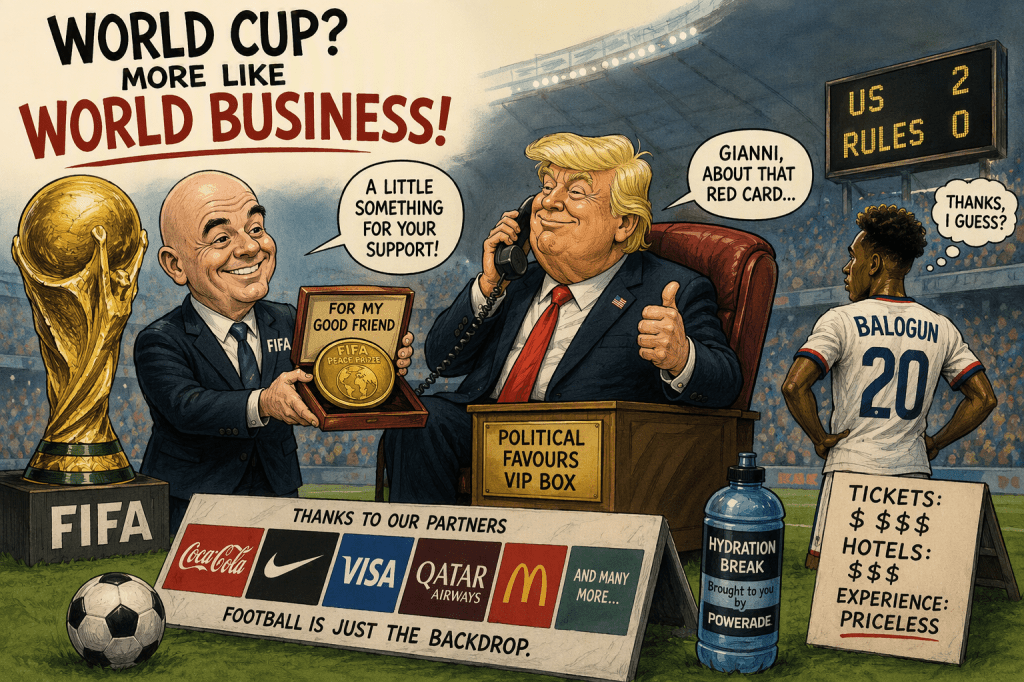
To be fair, perhaps we should stop calling it a football World Cup altogether. The term feels rather old-fashioned now, much like the notion that the competition exists primarily to determine the best team on the planet. Football still happens, of course, in the same way that music occasionally breaks out at the Eurovision Song Contest (see my blogpost on the ESC here). It just no longer seems to be the main attraction. Today’s World Cup is less a sporting event than a travelling trade fair with a ball. It is a month-long corporate festival in which sponsors enjoy unprecedented visibility – including during the so-called hydration breaks, broadcasters count their subscriptions, politicians search for photo opportunities and footballers provide the occasionally useful backdrop. The game itself increasingly resembles the decorative parsley placed on a restaurant meal: technically edible, but not really the reason anyone is there.
It is difficult not to admire the brilliance of the business model. FIFA has somehow managed to convince billions of people to organise their lives around a tournament while simultaneously charging them ever more for the privilege. Tickets cost a small fortune, hotel prices enter the realms of fantasy and a family wanting to attend several matches would be wise to begin saving shortly after the previous World Cup ends. Yet the stadiums remain full, the television audiences enormous and the cash registers ringing merrily. One suspects that if FIFA started charging spectators for oxygen inside the grounds, somebody would soon announce a premium “enhanced breathing experience”.
Then there is the politics. Every World Cup now seems to come with a supporting cast of presidents, prime ministers, royals, diplomats and assorted dignitaries eager to demonstrate their affection for the beautiful game. Few of them appear particularly interested in discussing pressing issues such as healthcare, education or public transport, but place them near a trophy and suddenly they become lifelong football enthusiasts. The tournament has become a global stage upon which political leaders can project influence, prestige and occasionally themselves onto giant video screens.
Of course, football administrators insist that sport and politics should never mix. This declaration is traditionally made moments before they pose for photographs with politicians, negotiate with governments or intervene in matters that appear suspiciously political. It is one of the great traditions of modern football, right up there with arguing with referees and England losing on penalties.
Still, despite all the commercial excess, political manoeuvring and shameless self-promotion, people continue to care. Perhaps that is because, every now and then, amid the sponsorship logos, presidential phone calls and executive jet flights, a match breaks out that reminds us why the World Cup captured our imagination in the first place. The trouble is that those moments increasingly feel like interruptions to the business meeting.
And let’s not forget, if President Trump has his way, Gianni Infantino could be the next UN Secretary-General. Ignacio Alonso, the president of the Uruguayan Football Association and a member of FIFA’s governing body would like to have the 2030 World Cup extended to 64 teams, which would be a third of the UN General Assembly’s sovereign member states.
Looking only at the modern era, FIFA has increased the field by an average of about 8 teams every 20 to 25 years, although the pace has accelerated recently. At this rate FIFA would theoretically reach universal representation somewhere around the year 2225, give or take a decade. Suppose FIFA divided 193 nations into 48 groups of four (with one group of five), followed by a knockout stage, that would mean roughly 480 games to be played in total. At 3 or 4 games per day, the FIFA World Cup would then last some 3 to 4 months – and hence provide ample time for photo ops and hydration breaks. The mind boggles..


I think the money aspect is reinforced when you consider that one possible, moral result of Trump’s meddling would be for a football association to say, “stuff this; this isn’t fair, and go home. I would have. But none of them did. Why? Money.
I mean, this would worry me if I were considering spending hundreds to go to a Premier League game. Will the game I see be rigged? I know the Premier League is not FIFA but there is a very short hop between the two. UEFA were right to object because they saw this.
Lastly, it is interesting to look at the pure question about what takes precedence, sport or politics. For me, it is politics every time. US football players going down on one knee was significant, boycotting South Africa was significant. Sport pales into obscurity in these cases.
LikeLiked by 1 person
On one hand I can understand this, as the millions of spectators in football make a captive audience for political statements, but this should not be an excuse. And then: Would you have expected any other behaviour from the current US administration? And yes, money rules now everything in football. And I fear it will get worse before – maybe – it gets better.
LikeLiked by 1 person
Yes I think the most we can hope for is that people comprehend that however much they might enjoy watching something, they are watching a business whose primary goal is to make money. But I have a problem in this area – I think that even advertisements should be forced to say, openly say “this is an actor” when you get someone saying “product x really is the best thing since sliced bread”.
But as long as people understand exactly what they are seeing, I can sit here and bemoan the days of Stanley Matthews, but otherwise I can’t raise a valid complaint. It’s really that lack of clarity.
Another small point – during COVID, football and horse racing were amongst the first sports to come back. Even in empty stadiums. Why? If there were no fans to appreciate the spectacle? To allow gambling to start up again as quickly as possible. It’s all about money.
LikeLiked by 1 person
I doubt that most people understand that even in their favourite sport it’s all about money. But then I suspect also that most don’t care as long as they enjoy what they are watching.
During COVID the stadiums were empty, but the races and games were still broadcast on television, so the captive audience was still there, just not in person…
LikeLiked by 1 person