
Apparently the average British worker produces roughly 10–15% less economic output per hour than workers in the US, Germany, France and Switzerland. Now this has less to do with the people themselves, but more with the environment In which they toil. The level of investment in technology and infrastructure, the quality of management and regional variations (London is apparently 15% more productive than Wales and the West Midlands for example) are determining factors.
Now there is another element to be considered: the heat. Although this year’s heatwaves are hopefully behind us, it is likely that we can expect more of these over the coming years. According to a joint analysis by the World Health Organization (WHO) and the World Meteorological Organization (WMO), each degree above 20 degrees Celsius reduces productivity by 2 to 3 per cent. So a peak of 35 degrees like during the heatwave this summer would reduce productivity by a staggering 30% at least. In theory, therefore, at 35 degrees we are only 70% as effective as at 20 degrees.
The underlying assumption appears to be that human productivity exists independently of environmental conditions. We have accepted that machinery overheats, battery performance deteriorates, road surfaces soften and train services struggle during a heatwave. Yet somehow the average knowledge worker is expected to remain a beacon of intellectual consistency regardless of whether the office temperature resembles a workplace or a sauna.
The first indication that things are not quite normal is not the heat itself. It is the sudden collapse of activities that normally require sustained concentration. A task that would take fifteen minutes on a rainy Tuesday in March mysteriously expands into a ninety-minute strategic initiative in July. The spreadsheet remains open. Progress is discussed enthusiastically. Various tabs are clicked with increasing determination. And yet somehow very little happens. The brain, recognising that survival is currently the higher priority, silently reallocates its resources away from complex analysis and towards assessing whether the desk fan has moved enough to justify repositioning oneself by three centimetres.
Meetings become especially fascinating during these periods. What would ordinarily be a lively exchange of ideas gradually evolves into a gathering of heat-stressed mammals attempting to preserve energy. Participants stare at presentation slides with the quiet intensity of archaeologists examining an undeciphered language. Questions are met with lengthy intervals of silence, not because people are reflecting deeply, but because several attendees have temporarily forgotten what the question was. Someone eventually offers a comment that contributes just enough momentum to keep the meeting alive, and the discussion drifts onward with all the urgency of a glacier.
The afternoon meeting deserves special consideration because this is where the laws of physics begin to exert their influence on corporate life. Around two o’clock, after lunch and several hours of exposure to rising temperatures, organisations undergo a transformation that management literature has largely ignored. Entire departments begin operating on what can only be described as emergency power mode. Cameras remain switched off, partly to conserve bandwidth but primarily to prevent visual documentation of the effects of thermal stress on professional appearance. Contributions become shorter, decisions become less ambitious, and action plans increasingly involve revisiting the topic once civilisation returns to a habitable temperature.
Even written communication suffers. The carefully crafted email, normally a masterpiece of diplomatic precision and detailed explanation, starts losing structural integrity. Paragraphs disappear. Adjectives are abandoned. Courtesy itself becomes increasingly expensive. By the peak of the heatwave, entire conversations can be conducted through messages containing little more than “Agreed” or “Let’s discuss next week”. Curiously, this may represent the single greatest productivity improvement that heatwaves have ever delivered.
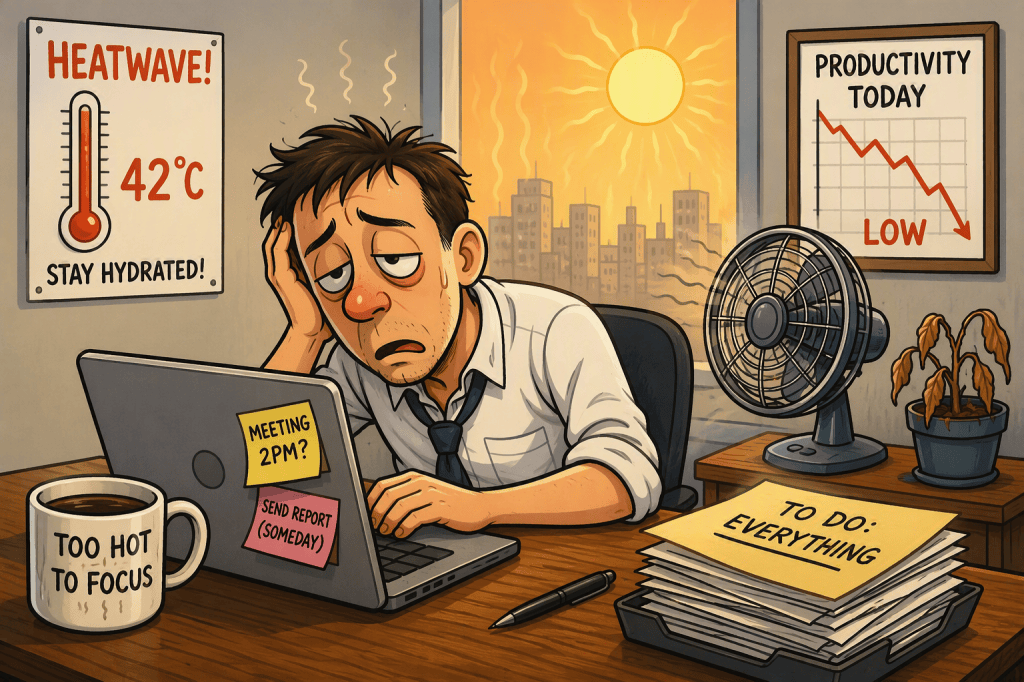
Naturally, organisations continue measuring performance throughout all of this. This feels somewhat unreasonable. Assessing intellectual output during a period of extreme heat is rather like evaluating a Formula 1 car while it’s stuck in city traffic. The conditions matter. Context matters. There comes a point at which success should not be defined by the completion of strategic objectives but by the ability to remain polite while wearing business attire in temperatures more commonly associated with Mediterranean beach holidays.
Given these realities, perhaps it is time to embrace a more enlightened approach to summer productivity. Rather than pretending the heat does not exist, organisations should adapt intelligently. For example, performance targets could be automatically adjusted according to temperature. Every degree above 25°C might reduce expectations by a modest percentage. By the time the thermometer reaches 33°C, simply remembering all the passwords required to start the day could justifiably qualify as exceeding objectives.
Similarly, there is a strong case for introducing mandatory cooling initiatives. The traditional coffee break, valuable though it may be, is clearly insufficient under extreme conditions. What employees require is a structured ice cream programme supported by executive sponsorship and subject to quarterly review. The precise business benefits remain unproven, but neither, to my knowledge, has anyone rigorously demonstrated the productivity advantages of sitting in a room that feels like the cargo hold of a container ship crossing the equator.
Dress codes might also benefit from reconsideration. The continued insistence on formal business wear during heatwaves suggests that many workplace policies were developed by people who rarely encountered direct sunlight. There is no strategic advantage in conducting meetings while dressed for a Victorian winter expedition. Professionalism should be measured by the quality of one’s contributions, not by the extent to which one is willing to perspire for organisational objectives.
And perhaps the most radical proposal of all is that we openly acknowledge a simple truth known for centuries in warmer parts of the world: productivity and temperature are engaged in an ongoing negotiation. The human brain is an astonishing instrument capable of creativity, analysis and innovation. However, it was never specifically engineered to produce quarterly forecasts while slowly cooking from the outside in.
Until science develops a climate-controlled force field for every office worker, we might all benefit from a little realism during the next heatwave. Drink more water, schedule fewer meetings, postpone unnecessary debates, and extend a little grace to colleagues whose thoughts appear to be moving through treacle. In the grand scheme of things, surviving a week of oppressive summer temperatures with one’s patience, humour and basic professionalism intact may itself be a remarkable achievement.
And let’s hope that when Britain suffers from a heatwave, so does the rest of Europe: at least that way productivity in comparison with our neighbours’ won’t be any worse than it already is.


I think everything becomes fluid during heat. I remember working in air-conditioned offices where the air conditioning was broken, not to mention braving the same conditions for hours on the train and/or the tube. It doesn’t help that English law in this area is littered with subjective words like “reasonable”. My point is that it is impossible to expect 100% from people who are enduring this.
LikeLiked by 1 person
In Switzerland ACs are the exception rather than the rules, particularly in older buildings, so I have spent my fair share of meetings in very hot offices.. even worse: as a consultant I was expected to be smartly dressed (at least without tie) whereas my clients‘ team would be sitting opposite me in shorts and t-shirts…
LikeLiked by 1 person
One thing I’ve noticed is that now I’m at home all the time, I can quite happily live with neither ac nor electric fans. It just goes to show that since I push myself far less, it takes a lot less for me to feel comfortable. This summer, I can’t tell you how good it felt to wear, like, 3 items of clothing, and to be dressed 🤣.
I must admit when I was consulting, I was happy to be (or at least accepted being) smart all year, if only because it promoted the myth that I was a cut above. It’s scary how important image was, but it was.
LikeLiked by 1 person
I must say, as I am getting older the heats seems to be getting to me, although I also now can dress down … and my wife now wants us to look into some AC fix for next summer.
I had suggested moving to Norway, but somehow this didn’t get her vote 🤣
LikeLiked by 2 people