
Artificial intelligence (I see no reason, at least for the time being to follow President Trump and call it super intelligence) is becoming prevalent in our daily lives and this includes electoral campaigning.
AI is a great productivity tool and hence is frequently used to create fundraising emails and press releases, but also to write speeches. Campaigns have also used AI to create attack ads and for predictive modelling. There’s nothing wrong with that, I presume, as long as this content is clearly labelled as such. As a voter I would like to know whether a campaign video depicts a real situation or has been synthetically generated to sway my opinion.
That elected officials use artificial intelligence can be a good thing, as this would hopefully make them more efficient and allowing them to spend more time with and listening to their constituents. Researchers from Chalmers University of Technology and Edinburgh Napier University analysed 4,209 UK parliamentary statements and 13,565 Swedish parliamentary motions from 2021 to April 2026. They estimated that about 15% of UK parliamentary statements in 2026 contained at least one paragraph classified as AI-generated or AI-assisted (the study examined parliamentary texts, not campaign speeches specifically). The interesting question therefore is no longer whether politicians use AI, but how much and what for.
Spoof social media posts and fake videos or even texts are now common methods to influence people and manipulate public opinion. The upcoming legislative elections at the end of this month in Israel, the midterms in the US and in Spain next month as well as the presidential election in France next April are no exception, and certainly a great opportunity for all parties involved (not to mention foreign agents) to further hone the deceptive capabilities of deliberately applied data science.
We have been here before, more precisely some 10 years ago during the Brexit campaign in the U.K. and the 2016 US presidential campaign. Although generative artificial intelligence did not exist then, Cambridge Analytica did use data science, machine learning and algorithmic profiling techniques that would today be considered part of the broader AI field. Many observers actually view Cambridge Analytica as a precursor to today’s AI-driven political campaigns: the Brexit operation was largely about using algorithms to find the right voter, whereas modern AI drives are increasingly about creating the right message as well.
The second Trump presidential campaign and affiliated groups experimented with AI-generated imagery and digital content. More broadly, 2024 is often described by researchers as the first major election cycle in which generative AI became a significant campaign tool and multiple US state and local campaigns use AI-generated ads, synthetic voices and AI-edited images, prompting growing regulatory scrutiny and new disclosure rules.
So can we actually still trust the politicians (assuming that we ever could anyway obviously)? Does a politician believe what he says when he reads an AI written speech? And does he actually understand the policies behind it? Politicians were never a uniquely trustworthy profession. Churchill once remarked that political promises should be examined carefully. De Gaulle famously said that politicians become statesmen when they think about the next generation rather than the next election. The tension between persuasion and truth is as old as democracy itself.
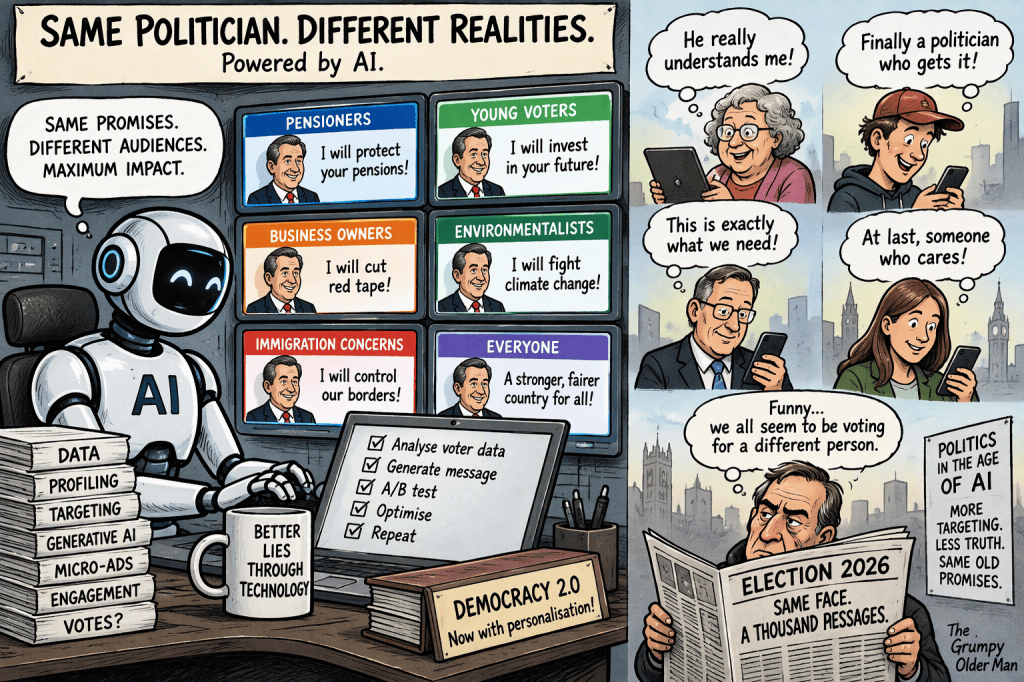
What has changed since the days of Cambridge Analytica is that the process can now become much more personalised and automated. A campaign can potentially tell pensioners one thing, students another, small-business owners something else, all generated and refined at scale. That creates a risk that voters no longer hear a common message, but thousands of slightly different ones optimised for them individually. And it is only with hindsight that we’ll find out whether these different messages stack up to a coherent whole.
Once upon a time, politicians hired speechwriters. Now they hire algorithms. The technology has changed, but the temptation remains the same: tell people what they want to hear and hope they never compare notes. The real danger is not that machines will take over democracy. It is that democracy becomes a never-ending exercise in data-driven flattery, where every voter hears a slightly different promise and nobody hears the whole truth. AI may be able to write the perfect campaign message, but it still cannot deliver the perfect government. In that sense, artificial intelligence may not be a revolution in politics at all. It may simply be the logical next step.
For those who want to delve deeper into the Cambridge Analytica story I recommend ‘The Great Hack’, a documentary available on Netflix.


I’ve often thought that we need to go back to first principles when deciding how to vote. Because there is so much noise surrounding politicians near to election time.
LikeLiked by 1 person
Very true! And it’s probably getting worse as AI evolves..
LikeLike